

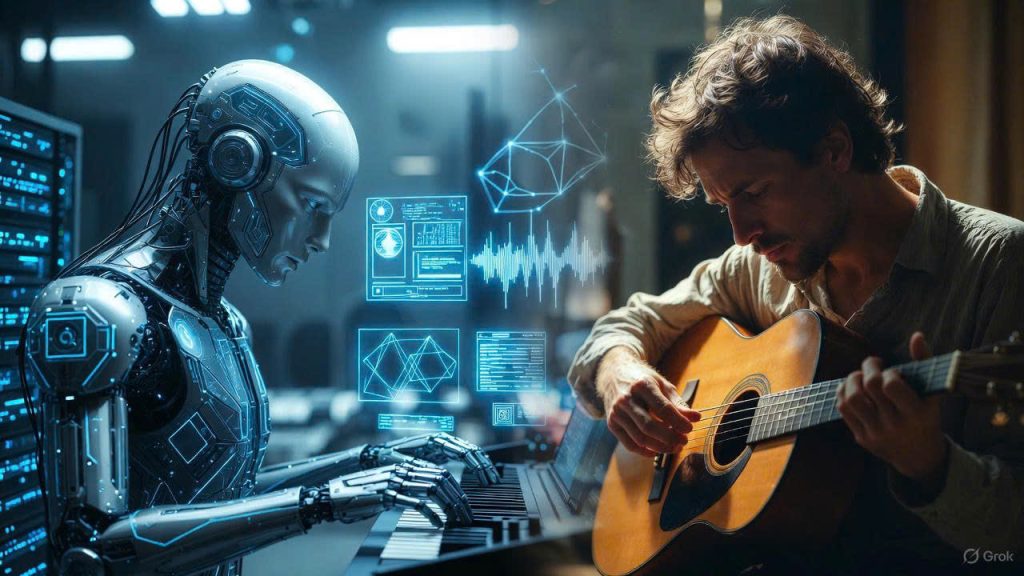
Sometimes, it takes just a small moment in life to make us reflect on the future of creativity. For me, it began with… a single click.
I saw a new rock-ballad on YouTube and clicked play. Instantly, my daughter asked, “What are you listening to, Mom?” The tone of her voice carried more than curiosity – it was suspicion: “Is that… machine music?” That brief exchange revealed two common attitudes toward AI-generated music today: openness and hesitation.
Two Perspectives – Two Definitions of Creativity
Those on the “traditional” side believe true creativity only exists when humans remain the center of emotion. For them, music is not merely a product but a journey of expressing the soul- distilled from experience, knowledge, and even pain.
The “emotion-first” listeners, on the other hand, only care if it sounds good. They don’t mind who or what composed the song – as long as it moves them.
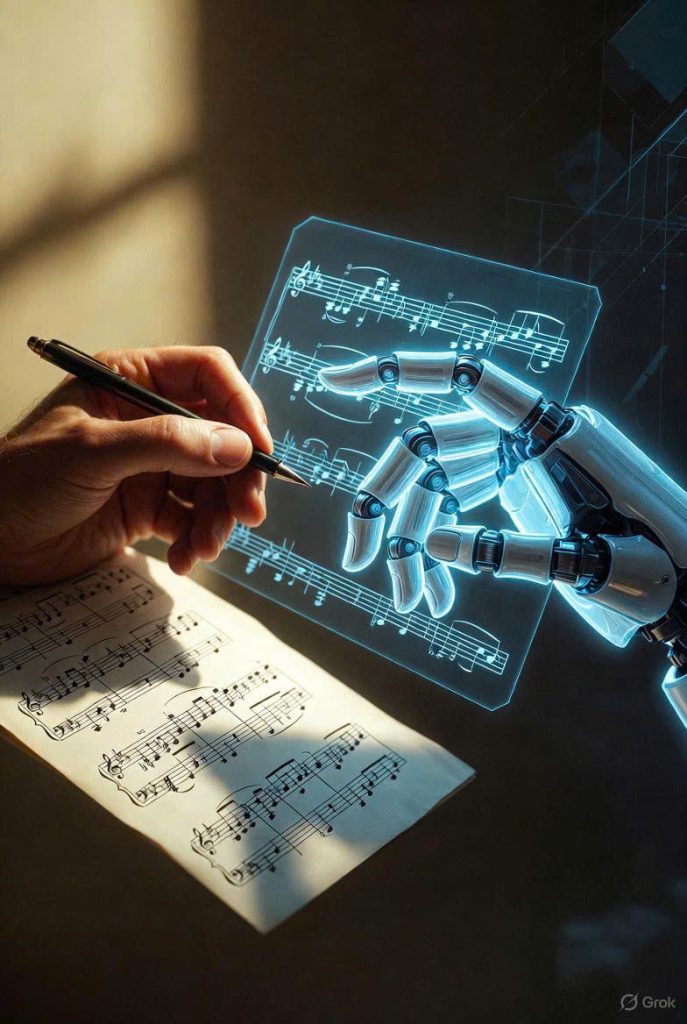
“Say” and the AI Music Wave
When the AI-generated song “Say” went viral on TikTok Vietnam, it quickly became a phenomenon, amassing millions of plays across social platforms. The melody was catchy, the rhythm infectious, the lyrics familiar – and above all, it sounded real.
Listeners didn’t care who the author was; if it matched their mood, that was enough. In the fast-paced digital world, where instant emotion rules, AI music seems to pulse perfectly with the public’s heartbeat.
Like “Say”, platforms such as Suno and Udio have created millions of AI-generated tracks. According to the Music Industry Outlook 2025, global music revenue rose by 17.2% thanks to AI-generated content. Yet, both platforms now face lawsuits from the Recording Industry Association of America (RIAA) for training their models on copyrighted audio (Billboard, 2024).
This raises the question: is AI truly creating – or merely copying at scale?
Experience with Uno – and the Feeling of “Disillusionment”
The first time I tried Uno, an AI music composition software, I eagerly entered the lyrics and prompts – and just a few minutes later, the machine produced two love songs. At first, I was intrigued – it felt like playing a small creative game. But as I listened more closely, the vocals sounded awkwardly accented, the melodies oddly similar, and the lyrics were sometimes rewritten in ways that made no sense.
Whether commercial or free, AI-generated music still feels rigid, lacking the warmth of a human soul. After a while, I could easily tell which songs were made by AI – and that feeling of “disillusionment” remained.
Astonishment – and Weariness
YouTube and TikTok in Vietnam are now flooded with AI-“remixed” tracks based on original songs – from pop and jazz to even bolero. What surprised me wasn’t the quantity, but the listeners’ reactions: they were moved, leaving countless comments praising the pieces, comparing them to “AI singers,” asking for karaoke beats… many unaware (or unconcerned) that the songs were machine-made.
According to Forbes (2025), the global AI music market is projected to reach 6.2 billion USD (Forbes Technology Council). Many independent artists feel they’ve been “dissolved in an ocean of algorithms.” Yet this very reality drives them to rediscover the human soul – something AI can never replicate.
Young Musicians and AI: The Democratization of Creation
For the younger generation, AI opens an entirely new world.
In the past, releasing a song meant overcoming a long chain of challenges: composing, arranging, recording, publishing. Now, just a few clicks can produce a complete track.
The Music Creators Report 2025 notes that about 60% of young musicians use AI in production, reducing music-making time by 50%. This marks a milestone in creative democratization – anyone can now “make music” without studios or expensive instruments.
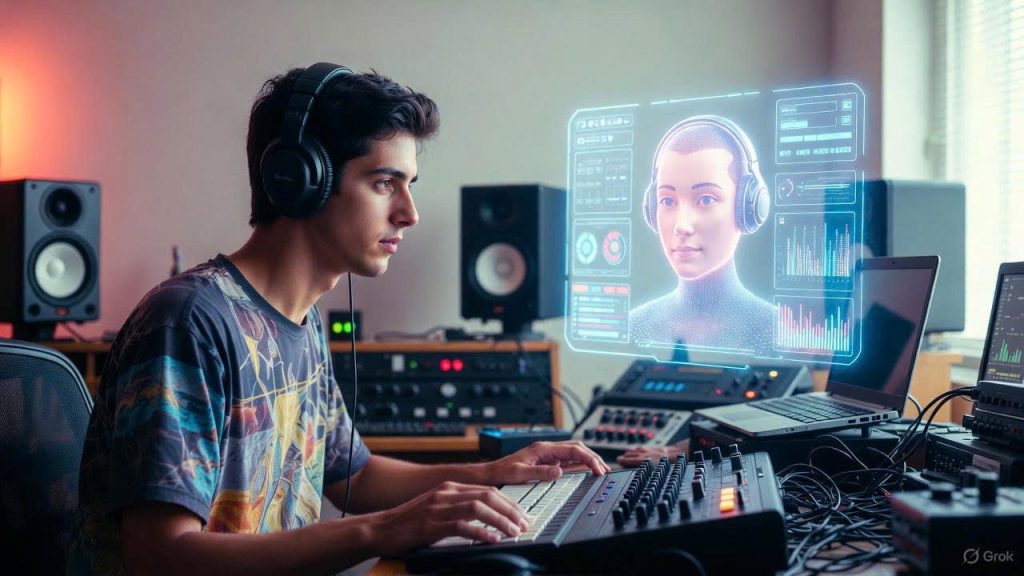
When Emotion Turns Into Algorithm
But convenience comes with risks. Overreliance on tools can dull genuine musical sensitivity – the ability to feel, write, and be moved by real emotion. AI can give them songs, but it cannot make them musicians.
The difference lies here:
- Those who use AI to learn, explore, and experiment grow with every track.
- Those who depend entirely on AI stop at “listenable” music – soulless but functional.
According to MIDiA Research (2025), 30% of AI-generated songs achieve commercial success, yet most are rated as “emotionally hollow.” Many artists are now turning to ethical AI tools like Soundverse, trained solely on licensed data.
The Future: Partner or Rival?
Perhaps in the near future, composers will no longer just write songs but teach AI how to feel – to understand sorrow, love, and silence. Then, music won’t disappear; it will simply evolve – from “handwritten” to “intelligently extended.”
According to the U.S. Copyright Office (2025), AI may be recognized as a legal co-author, but creative rights must still protect humans through an opt-in licensing framework (Copyright.gov, 2025).

Between Creation and Replication
The more I observe the rise of AI music, the more I wonder: what truly defines creativity? Perhaps it’s not just producing something new, but the presence of a soul in every note.
AI can imitate emotion but cannot feel it. It can compose songs that move us, yet it does not understand why we cry when hearing them. Humans, even with clumsy lyrics, carry lifetimes of love, loss, and wonder within their music. That’s what makes it alive – not data patterns.
A Pause for Reflection
Music has always been the language of the heart – not a byproduct of algorithms. AI music may make us “sway” for a few minutes, but only humans can truly touch one another through real heartbeats.
And perhaps, the real danger is not that AI can compose – but that we may one day stop wanting to listen to human music.
In an age where everything can be created with a few lines of code, the rarest thing of all is still this: to listen – and to feel – with a real human heart.
References
• Billboard: RIAA Files Lawsuit Against AI Music Startups Suno and Udio (2024)
• Forbes Technology Council: The Rise of AI Music (2024)
• MIDiA Research: AI Music Impact Report 2025
• U.S. Copyright Office: Artificial Intelligence and Copyright (2025)